


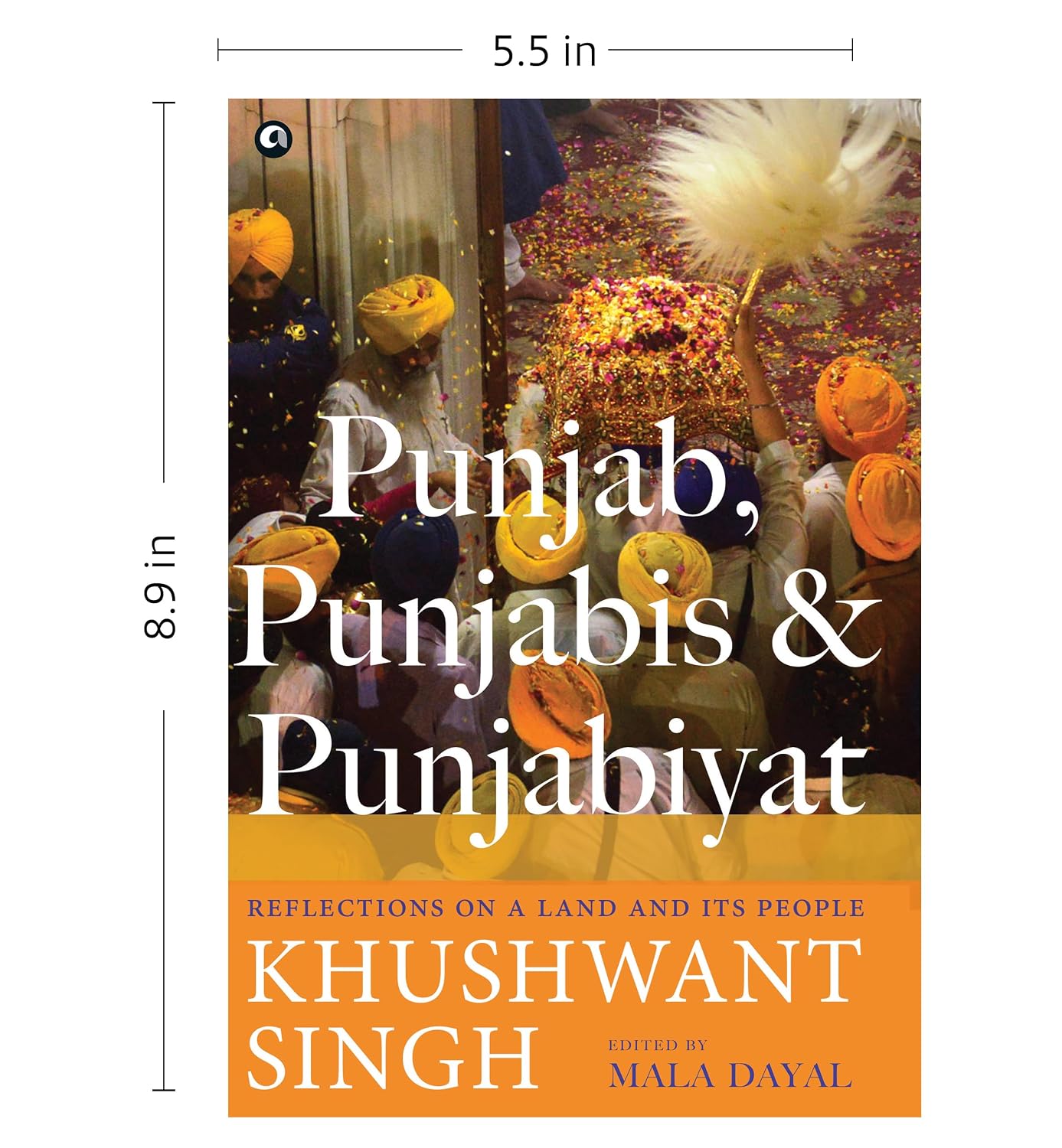

Price: ₹599.00
(as of Mar 25,2025 15:24:08 UTC – Details)
Buy Now
From the Publisher

Conversation with Khushwant Singh
THE LAND AND ITS PEOPLE
PUNJABI HOMELAND
Punjab has a geographical unity distinct from the neighbouring countries and the rest of India. It is shaped like a scalene triangle balanced on its sharpest angle. The shortest side is in the north and is composed of the massive Himalayas, which separate it from the Tibetan plateau. The western side is bounded by the river Indus from the point it enters the plains to another point 1,650 miles downstream, where it meets the confluence of Punjab’s rivers at a place appropriately named Panjnad—the five streams. Westwards of the Indus runs a chain of rugged mountains, the Hindu Kush and the Sulaiman, pierced by several passes like the Khyber and the Bolan, which have served as inlets for the people of the countries which lie beyond, Afghanistan and Baluchistan.

The eastern boundary of Punjab’s triangle is not clearly marked, but from a point near Karnal where the Yamuna plunges southeastwards, a jagged line can be drawn up to Panjnad, which will demarcate the state from the rest of Hindustan and the Sindh desert. Punjab, except for the salt range in its centre, is an extensive plain sloping gently down from the mountains in the north and the west towards the desert in the south. Across this monotonously flat land flow six large rivers: the Indus, Jhelum, Chenab, Ravi, Beas, and Sutlej. In the intra-fluvial tracts or doabs between these rivers and in the western half of the tract between the Sutlej and the Yamuna, live people who speak Punjabi and describe themselves as the people of Punjab. The homeland of the vast majority of the Sikhs is in the doabs between the Chenab and the Yamuna.

THE NAME: PUNJAB
When the first settlers from Central Asia came to India, there were seven rivers in Punjab, so they named it Sapta Sindhva, the land of the seven seas. The Persians took the name from the Aryans and called it the Hafta Hindva. Sometime later, after the seventh river, the Sarasvati, had dried up, people began to exclude the Indus from the count (since it marked only the western boundary of the province) and renamed it after the remaining five rivers as Pentopotamia or the panj-ab, the land of the five waters.
CLIMATE AND LANDSCAPE
The climate of Punjab ranges from bracing cold in the winter to scorching heat in the summer. Extremes of temperature and the two monsoons produce a variety of seasons and a constantly changing landscape.
Spring is traditionally ushered in on Basant Panchami, which falls early in the month of February. It is Punjab’s blossom time, when, in the words of Guru Nanak, ‘all is seemly; the woodlands are in flower and loud with the humming of bumblebees’. The countryside is an expanse of mustard yellow, broken by solid squares of green sugarcane with its fluffy pampas plumes. If the winter monsoon has been good, a crop of wheat, barley, gram, oilseeds, and tobacco will cover the land with lush abundance. Peasants supplement the rain by canal water or, where there are no canals, by Persian wheels turned by bullocks or camels. Around the wells grow vegetables: carrots, radishes, cabbages, and cauliflower. Branches of jujube trees sag under the weight of their berries. In springtime, the sounds that pervade the countryside are the creaking of Persian wheels, the call of partridges, and the monotonous kooh kooh, of flour mills.
The sugarcane is cut, its juice squeezed out, boiled in large cauldrons, and solidified into dark brown cakes. The canary yellow of the mustard is replaced by newly sown cotton and the golden-brown of ripening wheat—and we know that spring has given way to summer.
Trees shed their leaves and after a short period of barrenness come into blossom. While the margosa is still strewing the earth with its brittle ochre leaves, the silk cotton, the coral and the flame of the forest burst into flowers of bright crimson, red, and orange. Even the thorny acacia, the commonest tree of Punjab, is covered with tiny pale pom-poms. Persian wheels and the partridges are silent: instead there is the screaming of the koels in the mango groves and the crying of barbets.
The wheat is cut and winnowed in the warm breeze. In the words of Guru Nanak: ‘The sun scorches…the earth burns like an oven. The waters give up their vapours, yet it burns and scorches relentlessly.’ The temperature rises to a fever heat.
The parched earth becomes an unending stretch of khaki with dust-devils spiralling across the wastes. Even the stolid peepal and the tamarisk are shorn of their leaves and the only green that meets the eye are bushes of camel-thorn, prickly cactus, and the ak—calotropis. The succession of hot days and shimmering mirages is occasionally broken by fierce storms which spread layers of dust and sand over everything. All through the torpid afternoons comes the call of the brainfever bird in a rising crescendo, peeooh peeooh. On moonlit nights one can see the wavering arrowhead formations of geese honking their way northwards to the snowy Himalayas.
The blazing inferno lasts from the end of April to the end of June. Then come the rains.
The monsoon makes a spectacular entry. It is heralded by the monsoon bird, the pied-crested cuckoo, which fills the dusty plains with its plaintive cries. The colourless grey sky suddenly fills with dense masses of black clouds. There are flashes of lightning and the earth shakes with the rumble of thunder. The first big drops of rain are swallowed by the dust and a heavenly fragrance rises from the earth. Then it comes in torrents, sheet upon sheet, and continues for several hours. Thereafter the skies are frequently overcast; clouds and sunshine contend for dominion; rainbows span the rain-washed landscape; and the setting sun fires the bulbous clouds in hues of red and purple. Two months of incessant downpour turn the land into a vast swamp. Rivers fill up and become a mass of swirling, muddy waters. Punjabis, who have to live through many months of intense heat every year, love the monsoon. It is the time for lovers’ trysts and the reunion of families. Guru Nanak went into raptures over it: ‘The season of the rains has come and my heart is full of joy…river and land are one expanse of water… The nights are dark. Frogs croak in contentment. Peacocks cry with joy. The papeeha calls peeooh peeooh. The fangs of serpents and the stings of mosquitoes are full of venom. The seas have burst their bounds in the ecstasy of fulfilment.’ Life begins afresh. There are new leaves on many trees and grass covers the barren ground. Mangoes ripen. The clamour of the koels and the brainfever bird is drowned in the song and laughter of girls on swings in the mango groves.
By the time the monsoon is over, it is cool again. The dust has settled and the countryside is green once more. If the summer monsoon has been good—neither too sparse to create a drought nor too heavy to cause floods—all is well. A new crop of rice, millet, maize, indigo, and pulses of many kinds is sown. The peasants wind brightly coloured and starched turbans round their heads, put on waistcoats covered with mother-of-pearl buttons, tie bells round their ankles, and dance the bhangra to the beat of the drum. From October till Diwali in November there is a succession of fairs and festivals.
There is little rest for the peasant. Cotton is to be picked and the land ploughed again for sowing wheat and gram. Persian wheels begin to turn. The kooh, kooh of the flour mills is heard in every village. Partridges call in the wheat fields. And at night one hears the honking of geese on their way back to Punjab.
Once more it is wintertime. The starlit nights are cold and frosty, the days full of blue skies and sparkling sunshine. The mustard is in flower, the woodlands are loud with the humming of bumblebees, and all is seemly once again.
Publisher : Aleph Book Company (20 August 2018)
Language : English
Hardcover : 208 pages
ISBN-10 : 9387561402
ISBN-13 : 978-9387561403
Item Weight : 320 g
Dimensions : 1.27 x 14 x 21.6 cm
Country of Origin : India
Buy Now